
 Averill Elisa Frankes
 Isabelle Côté
 Josh Stevenson
 Noah Schwarz
Oceans, beaches, coastlines, dense forests, and rivers are all part of the Atlantic Canadian landscape. For centuries, these natural features have shaped economic and social life across the region and have often been just steps away from people’s homes. But this close relationship between people and the environment is becoming increasingly complicated. As global temperatures rise, Atlantic Canada faces some of the most significant climate risks in the country, including rising sea levels, more frequent flash floods, storm surges, and wildfires.
These changes are already transforming the region—from the gradual erosion of the Northumberland Strait and Nova Scotia’s Atlantic coast to the dramatic impacts of Hurricane Fiona, which destroyed homes in Newfoundland and reshaped coastlines in Prince Edward Island. At the same time, recent wildfires have affected Atlantic Canada on an unprecedented scale.
What do these changes mean for where people live? How do different climate events affect the frequency, scale, and forms of population relocation across Atlantic Canada?
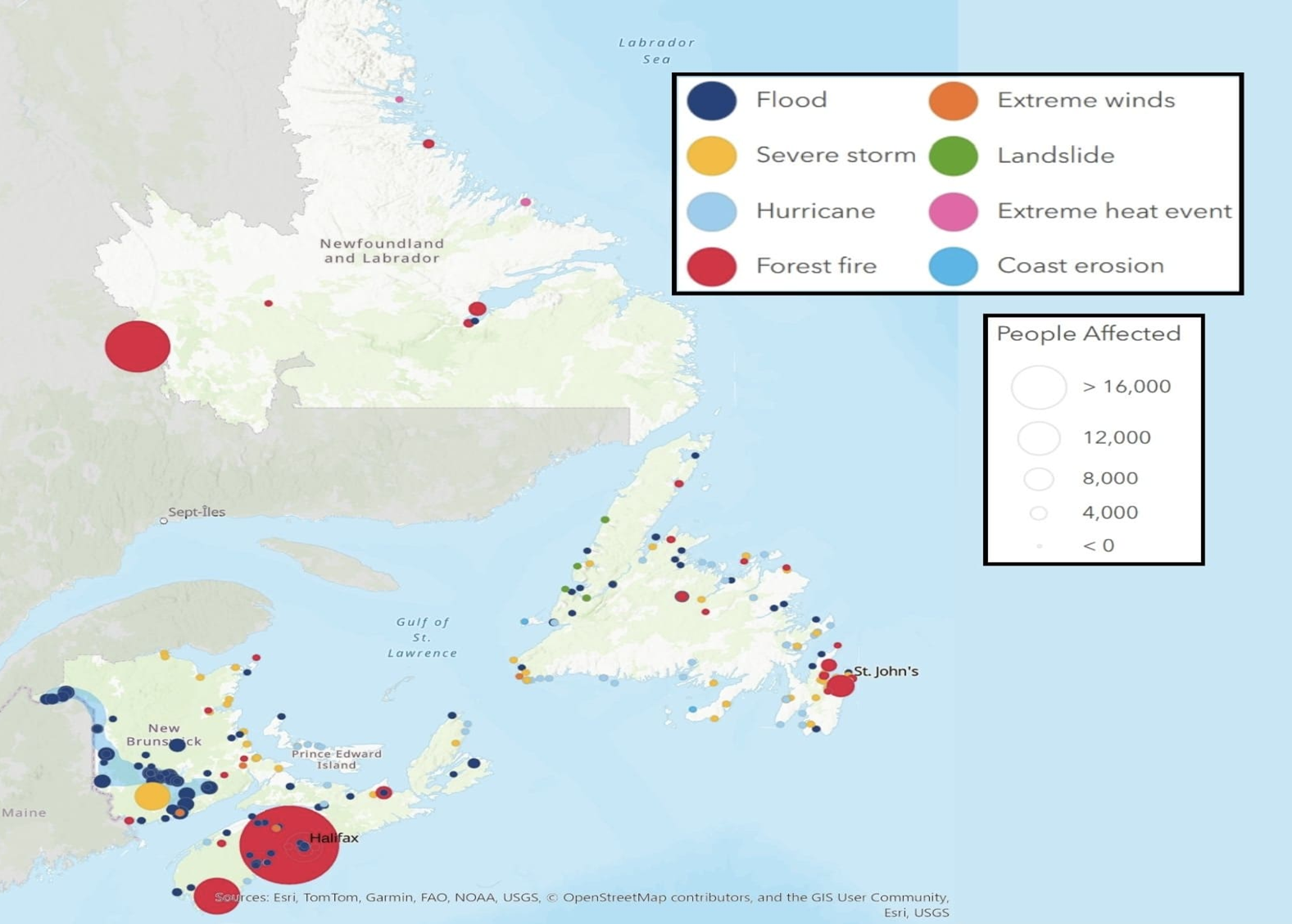
Drawing on news reports, archives, provincial records, and disaster databases, our team mapped patterns of climate-induced relocation across the four Atlantic provinces from 2000 to 2025. We identified 290 climate-related events that resulted in people being temporarily evacuated or permanently displaced (click here to explore our interactive map of climate-induced relocation in Atlantic Canada: www.climac.ca).
Our findings point to four important trends:
1. Climate-related relocation has increased dramatically in recent years
Over the 25-year period we examined, more than 72,700 people were temporarily evacuated because of climate-related events in Atlantic Canada. That is roughly 3% of the region’s population. A much smaller subset of the population, around 790 people, were permanently displaced, meaning that they were unable to return to their homes or place of residence.
But these relocations, both temporary evacuations and permanent displacement, have not been evenly distributed over time. Between 2000 and 2022, we identified 241 climate-related events that resulted in the temporary or permanent relocation of approximately 31,200 people. Between 2023 and 2025 alone, just 49 events resulted in the temporary evacuation of approximately 41,500 people –more than half of all the temporary evacuations recorded in our dataset–, the large majority of which (i.e. 26 events) were due to wildfires.
Important terms:
Relocation: The physical movement of individuals/groups to a new or different location.
Temporary Evacuation: The temporary relocation of individuals or groups from their homes or place
of residence.
Permanent Displacement: The permanent relocation of individuals or groups from their homes or place of residence. Only assigned when the permanent nature of their relocation was explicitly mentioned in the the original materials.
2. Different climate hazards produce very different kinds of relocation
One of our most striking findings is that different climate hazards produce different kinds of relocation. Floods are the most common type of event leading to relocation in our dataset. They account for about 41% of all the relocation-inducing events we identified. That being said, wildfires have forced far more people to evacuate. Between 2000 and 2025, wildfires accounted for approximately 51,600 temporary evacuations, compared with about 11,200 caused by floods. In other words, wildfires may occur less frequently than floods, but individual wildfire events can affect very large numbers of people at once.
When focusing solely on permanent displacement, we identified 790 people who were permanently displaced because of climate-related events during the period. This figure is very likely a conservative estimate considering that permanent moves are much harder to identify than emergency evacuations, and they can occur several months -if not years- after the climate event triggering the move. Among the documented cases, however, floods were by far the most important driver: accounting for 591 of the 790 permanent displacements.
These distinctions are important, as they underscore that climate-related mobility is not one single phenomenon. As Yarina and Wescoat’s research on climate-induced relocation explains, relocation can be temporary or permanent, voluntary or forced, planned or unplanned, and individual or collective. The timing, choices available to households, extent of government involvement, and consequences for communities are unique to specific event types and regions. It is also important to note that while it may begin as a temporary response, damaged homes, lengthy reconstruction, insurance problems or other barriers can make it difficult for people to return. Through these processes, short-term evacuations can lead to longer periods of displacement.
3. Property buyouts are becoming an important way of moving people out of harm’s way
So what happens when governments decide that rebuilding in a high-risk location is no longer the best option? The answer has increasingly been property buyouts. Under a buyout program, governments purchase properties located in areas at high risk of future disasters. The property is generally removed from residential use, while the former residents relocate elsewhere.
In Atlantic Canada, buyouts account for 644 of the 758 documented permanent displacements in our dataset. They have also been used in all four Atlantic provinces except Prince Edward Island, although their use varies considerably. New Brunswick accounts for the vast majority of documented buyouts and permanent displacements in the Atlantic region due to changes to its Disaster Financial Assistance Program, which capped some rebuilding assistance while expanding eligibility for property buyouts. For some households in high-risk areas, this made leaving rather than rebuilding in the same location a more viable option.
Buyouts are very different from emergency evacuations. They are slower, planned and generally involve individual households relocating from high-risk areas. They are one form of what researchers call managed retreat -i.e. the deliberate movement of people and property away from areas where climate risks are becoming increasingly difficult to manage. Research on managed retreat and property buyouts shows that these programs involve much more than simply moving houses: they raise questions about community attachment, fairness, compensation and who has the ability to move.
4. There is no single “Atlantic Canadian” experience
Finally, our findings show that climate-related relocation looks very different from one Atlantic province to another.
Nova Scotia experienced the largest number of recorded evacuations overall, with more than 35,000 people evacuated, as well as 122 permanent displacements. Floods were the most frequent hazard, followed by wildfires and hurricanes. In New Brunswick, floods are the most common hazard, followed by severe storms. The province recorded 9,361 evacuations and 548 permanent displacements in our dataset. In Newfoundland and Labrador, wildfires were the most common hazard, followed by floods. These climate events resulted in approximately 25,000 evacuations and 93 permanent displacements. Finally, Prince Edward Island experienced far fewer recorded relocations, and all of the evacuations and permanent displacement identified in our dataset were associated with Hurricane Fiona.
These inter-provincial differences matter. A community facing repeated river flooding may need very different solutions from one facing increasingly frequent wildfires or coastal erosion. This also means that government responses to climate adaptation cannot be a one-size-fits-all exercise in Atlantic Canada. Governments will need to prepare for emergencies such as wildfires and floods, while also thinking further ahead about communities that may face repeated or increasingly severe risks. That could mean better evacuation planning, stronger infrastructure, flood mitigation, coastal adaptation, or—when other options are no longer viable—support for people to move when they choose to.
Climate relocation is already part of Atlantic Canada’s future
Our ongoing research project challenges the idea that climate-related relocation is primarily a problem for distant countries of the Global South, or Canada’s Northern region. It is already happening across Atlantic Canada—and the pace appears to be increasing.
The region faces several different challenges at once: preparing for large-scale emergency evacuations, helping people return home after disasters, supporting households that need to relocate permanently, and thinking ahead about communities that may face risks that can no longer be managed where they are.
At the same time, relocation is not inevitable. Climate change does not automatically make people move. Whether someone leaves, stays, or is unable to return depends on much more than the hazard itself. Income, housing, insurance, government programs, attachment to place and the availability of alternatives all shape what happens next.
Atlantic Canada is therefore becoming an important place to study climate mobility. The region shows that climate-related relocation is not a distant possibility. It is already part of the changing landscape of life in Eastern Canada—and understanding it will be essential to preparing for what comes next.
Have you experienced climate-related relocation?
Have you experienced temporary or permanent relocation because of a climate-related event? Do you have comments or questions about our interactive map or the project more generally? We would like to hear from you. Contact our team at climac@mun.ca.





 Dariya Akhova
 Joao Victor Borba
 John Babb
 Katanan Touré
 Alliah Alvarez
 Sadaf Saeed
 Olivia Snook
 Tamsin Ford
 Cale Warren