
 Connor Crocker
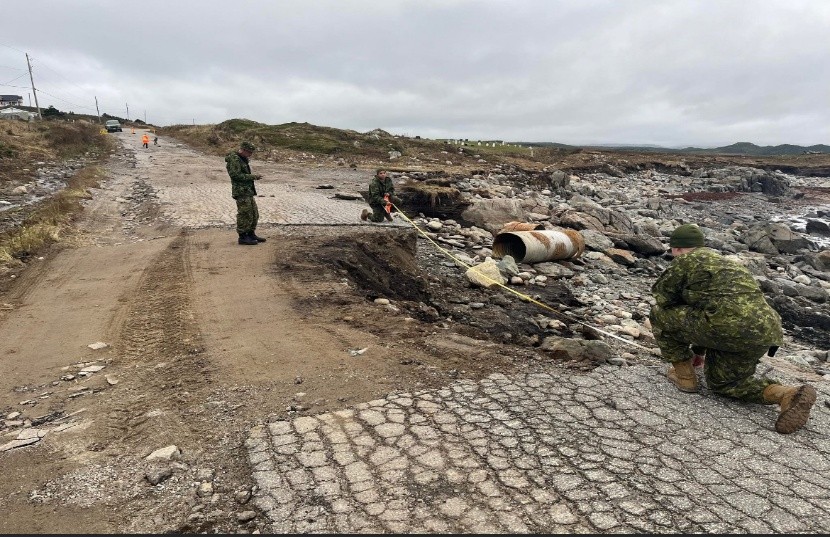
When Hurricane Fiona devastated Atlantic Canada in 2022, I was one of the Canadian Armed Forces personnel deployed to Port aux Basque, NL to assist with recovery efforts. I was deployed with my unit, 37th Combat Engineer Regiment alongside 12 other members of the unit, and a contingent of members from the Royal Newfoundland Regiment and 37th Service Battalion. While deployed, we worked with local volunteers and community members to travel to small communities along the coast and assist with debris clearance. We brought with us fuel, vehicles, and equipment that the local volunteers did not have access to, which allowed us to help to a greater degree. We were all also qualified in first aid and were prepared for long and strenuous days to assist wherever we could.
This experience shaped my understanding of how the CAF can provide assistance when disasters strike. Local volunteers were already working to help their communities, but our equipment, training, and the sheer number of personnel allowed us to provide support that was beyond those available to local communities. As climate related disasters become more frequent in Canada, what role can the CAF play?
Evolving threats to security
Traditionally, the military is associated with national defence and protecting Canadians from external threats. However, the concept of human security challenges us to think about security differently. Rather than focusing solely on protecting the state, human security emphasizes protecting individuals and communities from threats that endanger lives, livelihoods, and well-being. Climate change, natural disasters, and public health emergencies all fit within this broader understanding of security.
Operation LENTUS and disaster relief in Canada
The primary mechanism for military involvement in domestic disaster relief is Operation LENTUS, the CAF’s standing operation for response to natural disasters within Canada. According to the Department of National Defence, Operation LENTUS deployments have increased significantly as climate related emergencies have become more common. Provincial and Territorial authorities can request federal assistance when an emergency exceeds their capacity to respond. CAF personnel are able to provide a range of capabilities that their civilian counterparts often cannot rapidly generate; including transportation, engineering support, communication systems, logistics coordination, and large numbers of trained personnel.
Domestic military deployments have occurred, for instance, during major flooding events in Quebec and Manitoba, as well as during increasingly severe wildfire seasons in British Columbia and the Northwest Territories. The CAF has also provided additional training for personnel to support wildfire suppression. These domestic disaster relief deployments have been spread across the country aiding the different provinces and territories, with 8 Op LENTUS deployments being conducted in 2025 alone. This is a major increase in deployments, as the CAF has seen a total of 58 deployments between 1990 and 2023, with only 6 being between 1990 and 2010, with the first ever domestic disaster relief mission being undertaken in 1950, during the Red River Flood in Manitoba.
‘Mission creep’ and disaster relief
However, the growing reliance on the military for relief has sparked debate among policymakers and military leaders. Some argue that the CAF is experiencing “mission creep” and is being called upon too frequently for domestic emergencies. Vice-Admiral Mike Auchterlonie, then commander of Canadian Joint Operations Command (CJOC), has warned that the increasing number of domestic deployments places strain on military resources and personnel. Critics suggest that provinces and municipalities should invest more heavily in civilian emergency management capabilities rather than relying on the military as a solution.
These concerns are valid; the military cannot and should not be responsible for every emergency response in Canada. Nevertheless, the reality is that climate change is increasing the frequency and severity of disasters faster than many civilian institutions can adapt, and civil-military cooperation (CIMIC) in disaster response can strengthen Canada’s readiness. Until provincial and municipal governments significantly expand emergency management capacity, the CAF’s unique capabilities will continue to make it an essential component of Canada’s response framework.
Looking ahead
With increasing disasters striking communities and impacting people’s lives and livelihoods, Canadians are increasingly relying on more than local emergency responders. As climate change continues to intensify extreme environmental events, the Canadian Armed Forces have become an essential component of Canada’s human security framework. Through Operation LENTUS, the CAF provides resources that can be mobilized more rapidly and to a greater scale for when provincial and municipal governments become overwhelmed. My own experiences with Hurricane Fiona demonstrated the importance of having the CAF available when communities need additional support. While concerns about growing dependence on CAF for emergency relief are valid, the reality is that climate related disasters are occurring faster than civilian emergency services can respond, and until they are able to adapt, the CAF can continue to strengthen Canada’s human security by providing support to overwhelmed civilian responders that lack the resources needed. This was demonstrated again this year during the Eabametoong First Nation evacuation during the wildfire on July 18, 2026, when community members were evacuated from their community by airlift.


 John Babb

 Marta Pitino


 Heather Dicks
 Liam Swiss

 Cale Warren
 Averill Elisa Frankes
 Isabelle Côté
 Josh Stevenson
 Noah Schwarz
 Olivia Snook
 Tamsin Ford