 Joao Victor Borba
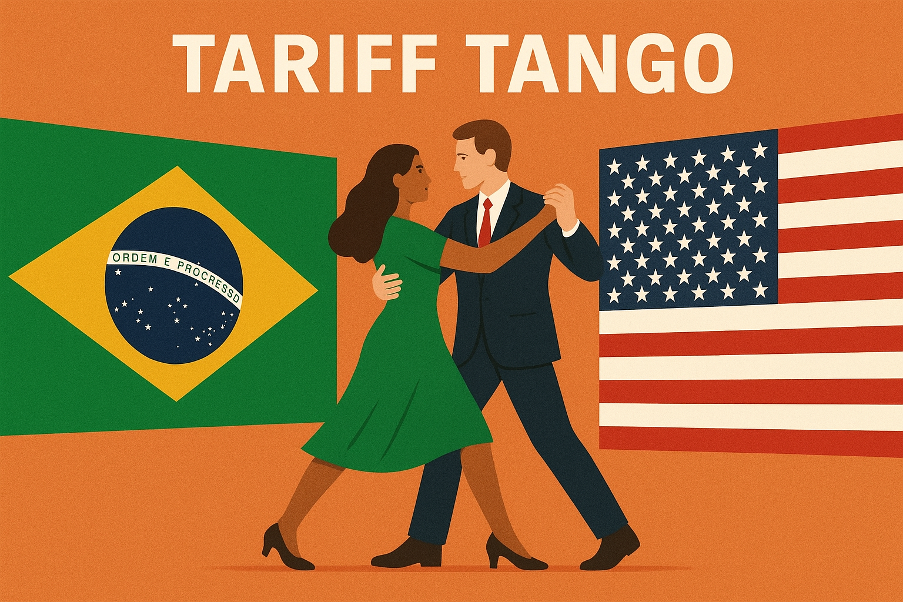
In July, the United States ignited a tense diplomatic tango by imposing a 50% tariff on most Brazilian imports, an escalation from the initial 10% baseline tariff announced in April. This move was formalized through Executive Order 14323 and became effective in August 2025. The imposition of these tariffs was justified by U.S. officials as a response to trade imbalances, Brazil’s support for BRICS policies deemed “anti-American,” and judicial actions perceived as threats to free speech and fair elections. Yet, data from the U.S. Trade Representative revealed a different reality: the U.S. maintained a consistent trade surplus with Brazil from 2007 through 2024, totaling over $29 billion in goods and services in 2024 alone. These tariffs, combined with the presence of other existing duties, exemplify the U.S’s anti-scientific governance: policymaking that dismisses empirical evidence in favor of political narratives, undermining international trade norms and bilateral trust.
For everyday Brazilians, the fallout from this tariff increase carries immediate consequences. Goods imported from the U.S., such as electronics and machinery, have increased in cost while export-dependent sectors face market uncertainty, threatening jobs in agriculture and manufacturing. Exemptions from tariffs were issued for key exports such as aircraft and oil, limiting the impact to about 36% of Brazilian goods by value. Still, affected sectors saw immediate disruptions.
From a security lens, economic strain caused by U.S.tariffs intersects with domestic political tensions, leading to potential erosion of institutional trust and amplified risks of unrest. And Brazil’s response? The swift launch of the “Sovereign Brazil” plan, which injected $5.6 billion in credit, guarantees, and tax relief to shield exporters and workers. However, the diplomatic dance has continued following the American imposition of sanctions on Brazilian judicial figures. A situation that raises the question: can domestic resilience counter foreign overreach?
The Tariff Escalation: From Trade Friction to Diplomatic Retaliation
The implementation of increased tariffs on Brazilian goods marked the opening step in this political tango. Yet the roots of this tension lie in a broader U.S. grievance over Brazil’s judicial independence. Despite the U.S. surplus, the Trump administration framed the relationship as “far from reciprocal,” citing non-trade issues like Brazil’s prosecution of former President Jair Bolsonaro for the failed 2022 coup plot.
Brazil’s countermove plan prioritizes three pillars: productive sector support, worker protection, and commercial diplomacy. It allocates resources from the Export Guarantee Fund for low-rate credit and insurance against order cancellations, extends tax suspensions, and boosts public procurement of surplus goods to absorb unsold exports. A National Employment Monitoring Chamber ensures job preservation, with benefits tied to maintaining payrolls. Early estimates suggest it could safeguard 500,000 jobs in export chains, while fostering diversification such as redirecting beef to China, which already absorbs 46% of Brazil’s output.
Yet the U.S. pirouetted with further force, launching a Section 301 investigation into Brazil’s trade practices, a unilateral U.S. mechanism allowing Washington to investigate and retaliate against “unfair” foreign practices without the involvement of the World Trade Organization. A method that often serves as geopolitical leverage rather than a means for economic remedy. The Trump administration further modified tariff scopes in November to include more agricultural goods before eventually issuing partial rollbacks. This progression from economic pressure to overt interference highlights how tariffs and domestic trade laws can become gateways for geopolitical maneuvering, straining alliances and global cooperation. However, Trump’s aggressive tactics ultimately failed. Despite the U.S. imposition of 50% tariffs and deployment of sanctions aiming to shield Bolsonaro, the U.S. ultimately backed down after meeting with President Lula, removing key levies as Bolsonaro began a 27-year sentence.
Legal Overreach: The Magnitsky Sanctions on Brazil’s Supreme Court Judges
Negotiations intensified when the U.S. directly targeted Brazil’s judiciary. The U.S. Treasury Department sanctioned Brazilian Supreme Court Judge Alexandre de Moraes under the Global Magnitsky Human Rights Accountability Act, accusing de Moraes of “censorship” and “human rights abuses” during Bolsonaro’s trial. Enacted in 2016, the Magnitsky Act authorizes asset freezes, visa bans, and transaction prohibitions against individuals responsible for gross human rights violations or significant corruption. Typically reserved for dictators, war criminals, or kleptocrats, the use of this act against a sitting judge in a country that is both democratic and an ally of the U.S. is unprecedented and widely seen as politicized.
Brazilian President Lula condemned the sanctions as “unacceptable interference,” vowing to defend Brazilian sovereignty. This escalation, initiated by the U.S. government, further exemplifies anti-scientific governance through the disregard shown to the independence of the Brazilian judiciary.
The Evangelical Echo: Ideological Ties Fueling the Fire
At the center of this tension is an ideological axis linking Bolsonaro, often called the “Trump of the Tropics”, to U.S. conservatives, amplified by Evangelical Christian networks. Bolsonaro’s populist, faith-infused rhetoric mirrors that of Donald Trump’s, appealing to skepticism of “globalist” institutions. Silas Malafaia, a key Bolsonaro ally, leader of the Evangelical church Assemblies of God Vitória em Cristo, collaborated with the ex-president, urging him to exploit U.S. sanctions for political gain and record videos for international support. Brazil’s Supreme Court banned Malafaia from contacting Bolsonaro, leaving Brazil, or using seized devices, citing evidence of coercion and obstruction in the coup probe. Eduardo Bolsonaro, currently in the U.S., has sought unsuccessfully to lobby for his father’s interests, whileMichelle Bolsonaro, the former president’s wife and a Christian preacher, remains a visible spiritual figure in the evangelical network that mobilized 27% of Brazil’s population in support of Bolsonaro during the 2018 and 2022 elections. The presence of this evangelical dynamic adds cultural depth to U.S.-Brazil tensions and underscores how transnational alliances, formed through evangelical leaders echoing U.S. narratives, can exacerbate tensions without directly driving policy.
Conclusion
The U.S. Brazil tariff saga reveals a clear pattern of anti-scientific governance that prioritizes political theater over facts and global norms. As leaders leverage false claims for short-term political gain, the result is diminished ethical credibility, weakened alliances, and eroded democratic resilience. While Brazil’s plan and judicial defiance signal the country’s resilience to foreign interference, the resulting rise in costs, job insecurity, and heightened political tensions pose risks to economic and social stability for both nations.
The tariffs imposed on Brazil and its diplomatic after-effects serve as a cautionary tale. When America, one of the world’s most powerful states, embraces denialism and disregards evidence, it harms bilateral relations and undermines the international system. The broader lesson is clear: the impact of anti-scientific governance is felt globally, with destabilizing effects for international institutions and the foundations of global cooperation. Confronting the forces driving this harmful form of governance may well be the defining challenge of our time.

 Isabelle Côté
 Mark Pablo
 Rachel Dion
 Rubiat Saimum